Friday, August 10, 2012

U.S. tops Japan for soccer gold in olympics


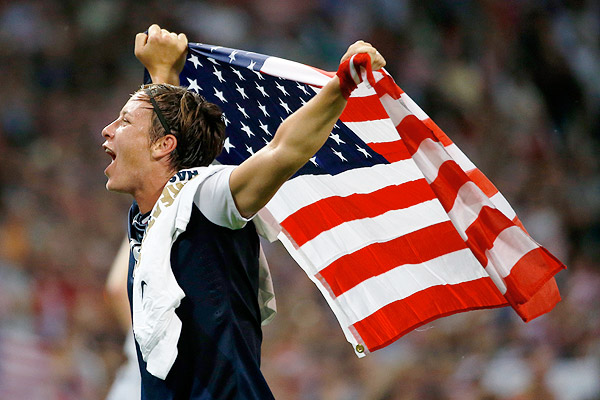
WEMBLEY, England -- Abby Wambach didn't put on her "Greatness Has Been Found" T-shirt right away. She instead strayed from her teammates and knelt alone at midfield -- and cried into a U.S. flag.
Yes, greatness has been found. And payback has been achieved.
The Americans are again on top of the women's soccer world.
The United States won its third straight Olympic gold medal Thursday, beating Japan 2-1 in a rematch of last year's World Cup final and avenging the most painful loss in its history.
"They snatched our dream last summer," U.S. midfielder Megan Rapinoe said. "And this kind of feels like the nightmare turned back around."
Carli Lloyd scored early in both halves, Hope Solo made a lunging late save as the Japanese pushed frantically for a tying goal, and the entire roster found the redemption it had been seeking since that penalty kick shootout loss in Germany last year.
"We came so close to winning the World Cup," Wambach said. "We knew if we put our energy and belief in each other into this year, we could pull off something special."
Before 80,203 fans at Wembley Stadium, an Olympic record for a women's soccer game, the teams put on a back-and-forth, don't-turn-your-head soccer showcase, proving again that these are the two premier teams in the world. Women's soccer is still in its formative stages in Britain, but the match proved more than worthy for the hallowed grounds of the beautiful game.
Back home, America was paying attention -- just as it was last year and despite all the other Olympic events. Even President Barack Obama, while visiting the U.S. Olympic Committee's training center in Colorado Springs, Colo., offered a "special shout-out" to the women's team for its victory.
"Congrats to the U.S. women's soccer team for a third straight Olympic gold. So proud," the President posted on Twitter.
At the final whistle, there was a group-hug celebration that unleashed a year of bottled-up frustration. Many of the players paraded with the flag and put on the celebratory T-shirts.
Solo was at center of the biggest scrum, fitting for a player who was so crucial to the victory. The goalie gets a lot of flak for her off-field pursuits -- including "Dancing With the Stars" and her candid comments on Twitter -- but she made several plays Thursday that showed again that she's the best in the world at what she does.
"Hope Solo, she says a lot on Twitter, I guess. I don't follow her," U.S. coach Pia Sundhage said. "But what matters is what kind of team player she is and how she performs. ... Today Hope Solo had a very good game. She brought the gold back to the United States of America."
Wambach, the outspoken co-captain who missed the Beijing Games with a broken leg, was always the player most impassioned about the mission to get the Americans back atop the podium. She had spoken of "nightmares" from the Japan defeat, and now they've been replaced by tears of happiness.
The loudest cheers erupted when she received her gold medal, and she was the only one to get a hug from American IOC member Angela Ruggiero, who put the medal around Wambach's neck.
"The Olympics is a perfect platform in terms of what life is," Wambach said. "You cannot win at everything you attempt in life. You have to be willing to fail and fall flat on your face in order to get glory. And we really did fail last year, in our opinion. We have to give Japan credit. They're a fantastic team.
"But anything less than winning for us is a failure. And we worked tirelessly all year long to prove that we still can win and we are still champions."
The U.S. team has won four of the five Olympic titles since women's soccer was introduced at the 1996 Atlanta Games, taking second place at the 2000 Games in Sydney.
Settling for silver, the Japanese players huddled together in defeat, with coach Norio Sasaki trying to encourage them. Karina Maruyama was inconsolable. Aya Miyama bowed her head and Asuna Tanaka wiped away tears.
But they were all smiles when they re-emerged for the medal ceremony, bouncing their way to the podium.
"Even though we got defeated and we couldn't win in this Olympics, if I look at it objectively, they all played very well," Sasaki said through a translator. "There is nothing we should be ashamed of."
Lloyd also scored the winning goal in the gold medal match against Brazil in Beijing four years ago.
[+] EnlargeAbby Wambach
Jamie Squire/Getty ImagesAbby Wambach celebrates after the United States defeated Japan on Thursday to win the women's soccer gold medal at Wembley Stadium.
On Thursday she found the net in the eighth and 54th minutes, making it four goals in the tournament for the midfielder who lost her long-held starting job weeks before the Olympics. She got back on the field when Shannon Boxx injured her hamstring in the opener against France and started every game since.
"I think I just come up big in big moments. That's what I've trained for," Lloyd said. "I worked my butt off day-in and day-out. I don't think there's anybody that works harder than I do. I was on a mission this Olympics to prove everybody wrong, and that's what I did. To show everybody that I belong on the field."
Yuki Ogimi answered in the 63rd minute, and Mana Iwabuchi nearly had the equalizer in the 83rd -- stripping the ball from captain Christie Rampone and swooping in alone against Solo -- only to be thwarted when the goalie flung her entire body to the left to push the shot away.
"I knew I had to make the save," Solo said. "That was pretty much my only thought. I had to make that save."
Throughout the game, Japan perhaps played just as beautifully as the Americans, using speed and discipline to dominate possession and scoring chances for long stretches. The Japanese were unfortunate not to have a penalty kick awarded in the first half for a clear hand ball by U.S. midfielder Tobin Heath, who stuck out her left arm to stop a free kick inside the area.
The Americans knew they'd gotten away with something.
"The one on Tobin?" Rapinoe said, smiling. "Thank God I'm not a referee."
Asked about the play, Japan coach Sasaki responded with a wry grin and said he wondered what the referee was thinking at the time. He diplomatically added that he respected the call.
Japan also had two shots hit the crossbar, one off the left hand of a leaping Solo, who was kept constantly busy for the first time this tournament. The closest the U.S. came to doubling the lead in the first 45 minutes came when Azusa Iwashimizu attempted to clear a routine ball played in front of the net -- and headed it off the post.
Lloyd's first goal began with a run by Heath down the left side. She fed Alex Morgan, who settled the ball near the goal line, spun and chipped it toward Wambach. Wambach raised her left foot for the shot, but Lloyd charged in and got to it first, her strong running header beating goalkeeper Miho Fukumoto from 6 yards out.
Lloyd extended the lead with a 20-yard right-footer just inside the left post after a run from midfield through the heart of the Japanese defense.
Ogimi soon cut the deficit to one after a mad scramble in front of the net. Rampone saved a shot off the line, but the ball went to Homare Sawa, who fed Ogimi for the tap-in.
Another scramble followed after U.S. defender Amy LePeilbet saved yet another shot off the line in the 74th minute, but this time her teammates were able to corral the ball before a Japanese player could pounce on it.
Boxx was back in the starting lineup after the missing four games with the hamstring injury. Lauren Cheney, who injured an ankle in the semifinals, began the game on the bench for the first time this tournament.
Canada won the bronze earlier Thursday, beating France 1-0 at Coventry.
The previous record crowd for a women's soccer game at the Olympics was 76,481 at the Atlanta Olympics. That game was played at Athens, Ga., which isn't quite Wembley.
"I reminded myself that I was at Wembley, and it is a final, and the players got the gold," the Swedish-born Sundhage said. "It's happiness. It's hard to explain in English. It's hard to explain in Swedish, anyway. Just the fact that you're standing in the middle of something huge."
Information from The Associated Press was used in this report

Arsenal fans can't accept Van Persie exit


Arsenal fans can't accept Van Persie exit

GMF poll: Signings of Lukas Podolski, Olivier Giroud & Santi Cazorla can't compensate for Robin van Persie exit


What next for RVP? (©GettyImages)

Just when it looked like Robin van Persie may reverse his decision and stay with Arsenal, the transfer saga involving the Dutch striker has taken yet another turn.
Arsene Wenger has been particularly busy in the transfer market this summer with the early additions of Lukas Podolski and Olivier Giroud followed by the reported club record addition of Spain international Santi Cazorla this week.
The acquisition of Cazorla, it was claimed, had led Van Persie to reconsider his position and, perhaps, put pen to paper on the contract Arsenal have strived so desperately to get their captain to sign.
However, the latest twist has seen Old Trafford emerge as the likely destination for Van Persie this summer, with Sir Alex Ferguson even going so far as to publicly confirm Manchester United had made a bid.
It would be fair to assume that, given the flurry of activity at the Emirates Stadium along with Van Persie's apparent disregard for their feelings, Arsenal fans would have accepted the grass may be greener on the other side of the 29-year-old's departure.
The signings of Podolski, Giroud and Cazorla represent an almost unprecedented statement from Arsene Wenger, and there is seemingly room for a genuine sense of optimism at Arsenal this summer.
However, a GMF poll has revealed that this optimism would immediately evaporate should Van Persie be sold, with Arsenal fans still unable to accept his seemingly inevitable exit.
GMF polled over 10,000 supporters, and they voted overwhelmingly to register their collective dismay that Van Persie could leave and, in doing so, claimed Wenger's summer signings would in no way compensate for his departure.
A sizeable 79 percent of fans do not envisage Podolski, Giroud and Cazorla would be able to fill the void if Van Persie was to leave, and perhaps suggests Wenger will be urged to invest even further if he lost his captain.
This does, however, also mean that over a fifth of the fans polled have accepted that Arsenal ought to cash-in on Van Persie this summer in order to prevent his position having a further detrimental affect on the club.


Usain Bolt seals his place in the pantheon with stunning fifth gold

Olympics badge

Usain Bolt seals his place in the pantheon with stunning fifth gold

Richard Williams at the Olympic Stadium watches the master beat the pupil – just – as Jamaica sweeps the board in the 200m

Usain Bolt after wining the 200m final
Usain Bolt poses with Warren Weir (left) and Yohan Blake (right), after Jamaica swept the board in the Olympic 200m final. Photograph: Jeremy Selwyn/NOPP
Shush, he told the crowd before the start. Calm down, he gestured. So serene was he, so unstressed by the whole thing, that after he had taken care of the necessary business he got down on the track and performed a few press-ups. In between times he ran 200m in 19.32 seconds: not a threat to his own world record, or even to his Olympic record, but certainly good enough to reassert his standing as the world's fastest man.
Yohan Blake, his compatriot and training partner, had beaten Bolt in the national trials at both 100 and 200m, and he did his best once again to give his rival a contest, finishing strongly and closing what had been a big lead as they came off the bend to a margin of 0.4sec – still an eternity – behind the great man. Warren Weir completed a devastating clean sweep of the medals for Jamaica.
As the runners bent to their blocks there was the unusual sight of the United States outnumbered in an Olympic 200m final. Before Thursday night the US had provided 18 out of the 26 winners since the event was first held in 1900, but Wallace Spearmon was the only compatriot of Jesse Owens, Tommie Smith and Michael Johnson on view. He failed to challenge the trio from Kingston's Racers Track Club, finishing fourth, ahead of Churandy Martina of the Netherlands and Christophe Lemaitre of France.
As if to celebrate the presence of Bolt and his fellow Jamaicans, London was blessed with glorious weather. Three more days of this and no one will go home from the 2012 Olympic Games with anything other than the memory of a perfect setting for the kind of athletic excellence enjoyed by another capacity crowd of 80,000.
The warmth arrived as if on cue to lubricate the limbs that broke world records while winning the 100m and 200m in Beijing, as well as the 4x100 relay. We knew less than a week ago that such an epochal feat would not be repeated in London.
On Sunday Bolt won the 100m, as expected, but his time of 9.63sec – although 0.6sec faster than the mark he set four years ago in Beijing, and therefore a new Olympic record – was still half a second off the world mark that he had achieved at the world championships in Berlin in 2009.
To capture the double of the 100 and 200m again in London, he had repeatedly claimed since achieving the feat for the first time four years ago, would make him a legend. Which raises the question of in whose mind, exactly, those staggering performances in 2008 had not automatically elevated him to that status.
For those of his own generation, the Jamaican's existence provides a special thrill: like growing up, in some ways, during the era of Muhammad Ali.
Even to those of us who lived through the eras of such dominant sprint champions as Bob Hayes, Valeri Borzov, Pietro Mennea and Carl Lewis, the 6ft 5in Jamaican represents a unique figure: a man who could break through generally accepted frontiers to set new standards of human achievement on the physical plane, taking rather less time than the scientists at Cern to redraw the map of mankind's potential.
Bolt sprints like no champion ever has. By greeting his audience with a laugh and a little dancing-fingers mime show, he single-handedly revoked the licence of sprinters to throw gangsta shapes on the start line. Henceforward their threatening, glowering poses would provoke only derision. And he appeared to question the idea that there was more to the job, as long as you had completed a modicum of training, than just turning up and running.
He ran, and can still run, even though the record-breaking years may be in the past, with the ease and naturalness of a gifted child at a school sports day. There is a sense of glorious, uncaring freedom long since lost to most sports in the professionalised, corporatised era.
His world records in Beijing and Berlin were not the kind of incremental improvements usually seen on the track, the onward nudges that made Roger Bannister the first man to run the four-minute mile in Oxford in 1953 or Jim Hines the first man to go under 10 seconds for the 100 metres in Sacramento in 1968. Nor was there the kind of environmental assistance like that which enabled Bob Beamon to break the long-jump record by 55cm in the thin air of Mexico City, 2,240m above sea level, during the 1968 Games.
Bolt's record-setting runs were quantum leaps, in the truest sense of the term: a shift from one state to another, without passing through the conventional intermediate stages. In the shorter event, a record that had been lowered over the years by the odd hundredth of a second here and there, taking 40 years to go from Jim Hines's 9.94 to Asafa Powell's 9.74, suddenly seemed to have missed several stages, going from Powell's 9.74 to Bolt's 9.58 – set in Berlin, a year after the Olympics – in under two years. In the 200m at the Beijing Games he took only two hundredths of a second off Michael Johnson's record of 19.32, but that was a mark, set in 1996, that had been expected to endure a great deal longer. In Berlin he lowered it further, leaving it at 19.19.
Those record-shattering days may be gone, to judge by his performances over the past week on what has appeared to be a very fast track. But no one who was in the stadium will have gone home anything other than profoundly grateful to have witnessed at first hand the author of such historic deeds on the Olympic stage.
Bolt's thunder is never completely stolen, but a large measure of it was appropriated by David Lekuta Rudisha, a 23-year-old from Kenya who knocked a tenth of a second off the 800m world record while winning a storming final. The remorselessly powerful acceleration of the tall 23-year-old in the back straight on the second circuit, taking him several metres clear of the field, was immediately reminiscent of Alberto Juantorena, the great Cuban who broke the record while winning the two-lap event in Montreal in 1976.
Fittingly, Juantorena was present to watch Rudisha's run. A few minutes after the 800m runners had left the track, he fulfilled the duty of assisting at the medal ceremony for the men's 110m hurdles. Now 61 and an official of the Cuban Olympic Committee, he would have been delighted to see his old event won in so distinguished and memorable a manner.


Van Persie set for £220k United contract

Van Persie set for £220k United contract

Arsenal captain Robin van Persie will be offered the same wages as Robin van Persie at Manchester United


Sir Alex Ferguson will offer Robin van Persie wages of £220,000-a-week to leave Arsenal - putting him on par with Manchester United striker Wayne Rooney. (Daily Telegraph)
Napoli have opened discussions with Chelsea over the £8million transfer of Raul Meireles - while Bolton boss Owen Coyle wants to take midfielder Josh McEachran on a season-long loan. (Daily Mail)
Liverpool have made an incredible demand of Manchester City - with Brendan Rodgers asking for winger Adam Johnson, plus £23million to trigger the sale of Daniel Agger. (Daily Mail).

Roberto Mancini is also weighing up a move for Brazil striker and reported Tottenham target Leandro Damiao. (Daily Mail)
And finally, Andre Villas-Boas has already identified a replacement for want-away midfielder Luka Modric - in the form of Partizan Belgrade star Mohamed 'Medo' Kamara. (Daily Mirror).


Usain Bolt's double gold: 'I'm now a legend. I am the greatest athlete to live'

Olympics badge

Usain Bolt's double gold: 'I'm now a legend. I am the greatest athlete to live'

Olympic double gold medal winner says he now wants to add a third to his London 2012 collection
The 2012 London Olympic Games, Athletics, Men's 200m, Britain - 09 Aug 2012
Usain Bolt celebrates in his trademark style after winning the men's 200m final at the London 2012 Olympic Games. Photograph: Rex Features
After proclaiming that retaining his 100m and 200m Olympic titles had made him a "living legend", Usain Bolt took aim at Carl Lewis for casting aspersions on the manner in which he had done so.
Lewis has hinted in the past that the drug testing programme in Jamaicais less rigorous than in other countries, but Bolt said Lewis was attention seeking. "Carl Lewis, I have no respect for him. The things he says about other track athletes is really downgrading other athletes," said Bolt after retaining his Olympic 200m title. "I think he is looking for attention because no one really talks much about him. I've lost all respect for him. It's really upsetting for me."
In 2008, Lewis said: "No one is accusing anyone. But don't live by a different rule and expect the same kind of respect. No country has had that kind of dominance. I'm not saying they've done anything for certain. I don't know."
Earlier, Bolt had said the dominance of Jamaica was the result of hard work and training: "When people doubt us it's really hard, but we try our best to show the world we're running clean." The Jamaican said that he would carry on running but that he would probably retire before he reached 30.
On defending his titles at the next Games in Rio, he said that he thought the competition from Yohan Blake and others would be too much: "I think I've had my time. In life, anything is possible but that's going to be a hard reach." After successfully defending his Olympic 100m and 200m titles, Bolt said that he had proved he was "the greatest athlete to live". Bolt, who won the 200m in 19.32 seconds to lead a clean sweep in front of his Jamaican compatriots Yohan Blake and Warren Weir, said the achievement put him in the same category as his hero Michael Johnson.
"It's what I came here to do. I'm now a legend, I'm also the greatest athlete to live. I am in the same category as Michael Johnson," he said after finishing in the same time as Johnson's former world record. Bolt said that he felt inhibited by a back injury that has troubled him this season - yet still appeared to have something to spare as he crossed the line.
"The 200m was harder than I expected. I could feel the pressure coming off the bend and that's when I had to focus."
Weir revealed that before the race, Bolt had come up to him and said "one, two, three" and the trio completed a lap of honour that turned into an entertaining sideshow for the 80,000 present.
"It's wonderful. Jamaica has proven that we are the greatest sprint country. I've got nothing left to prove. I've showed the world I'm the best and, right now, I just want to enjoy myself," said Bolt. "This is my moment. I'll never forget this. Lane seven has been good to me these past couple of days."
Before the start of the race, Bolt had joked and bumped fists with the volunteer holding his kit. After storming to victory, he did press ups on the track and borrowed a photographer's camera to take pictures of his friend and training partner Blake.
Bolt didn't have it all his own way in terms of era defining performances as Kenyan 800m runner David Rudisha became the first person to break a world record on the Olympic Stadium track.
Asked afterwards whether he fancied splitting the difference and taking on Bolt over 400m, he said: "It would be great fun, let's do it."
Bolt said he was also determined to now enjoy his achievement as he focused on the possibility of adding a third gold medal to his London 2012 collection: "It's all about the 4x100m now, to have some fun and go out there and do our best."